


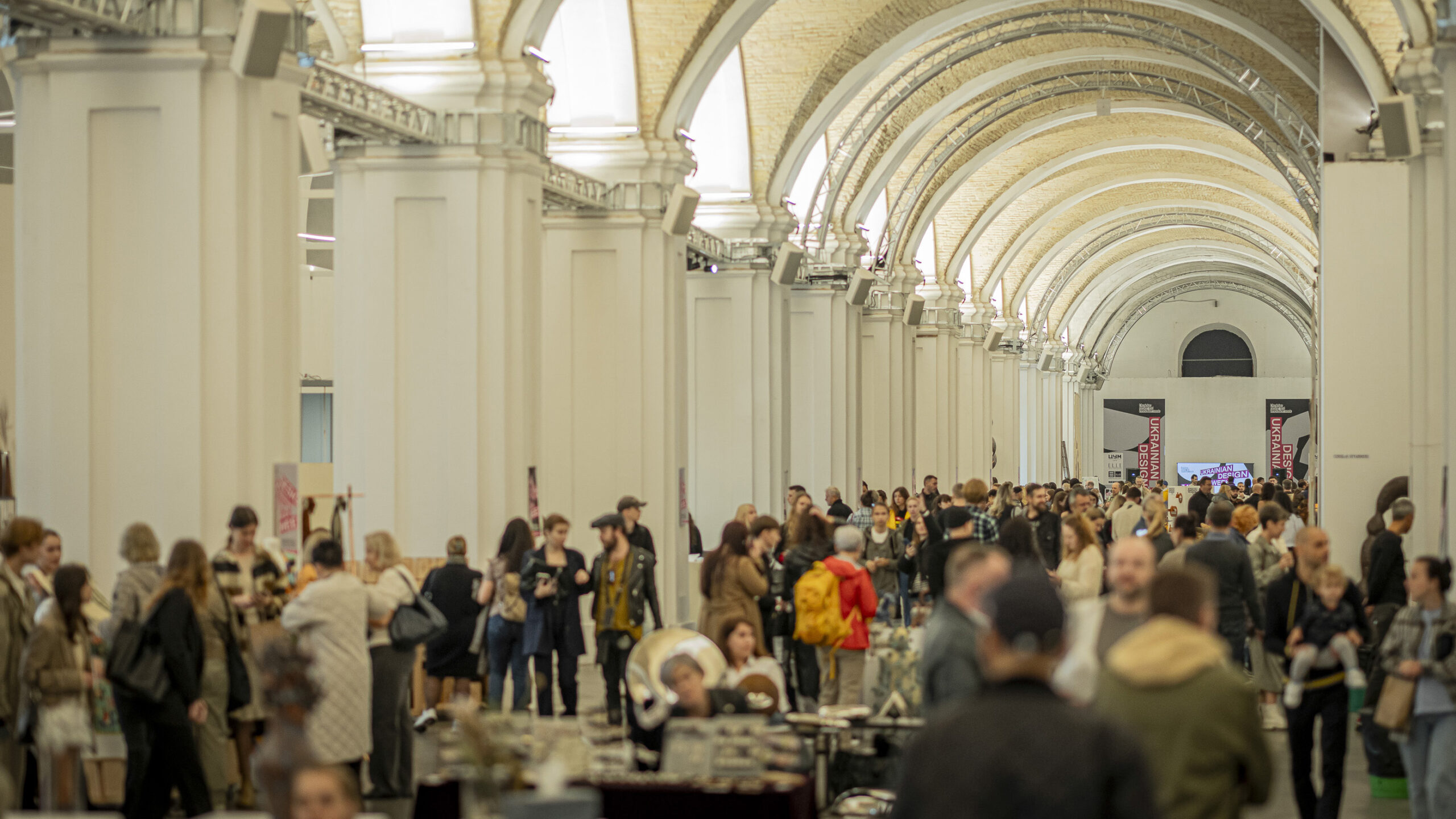
Gallery exhibitions, film screenings, cultural events and 100 of the best Ukrainian brands of lighting, furniture, decor and object design, which placed their expositions on an area of 1000 square meters – these were the first two days of UDIW. Guests who came here for fresh ideas and interesting products for the home were able to familiarize themselves with new products from Shishka project, kint, MAKHNO Studio, NOOM, Gunia, Gushka, DIZA, +kouple, Tivoli, Litvinenko, Clayp, 4 corners and many other brands and leading and young designers who collaborate with them.

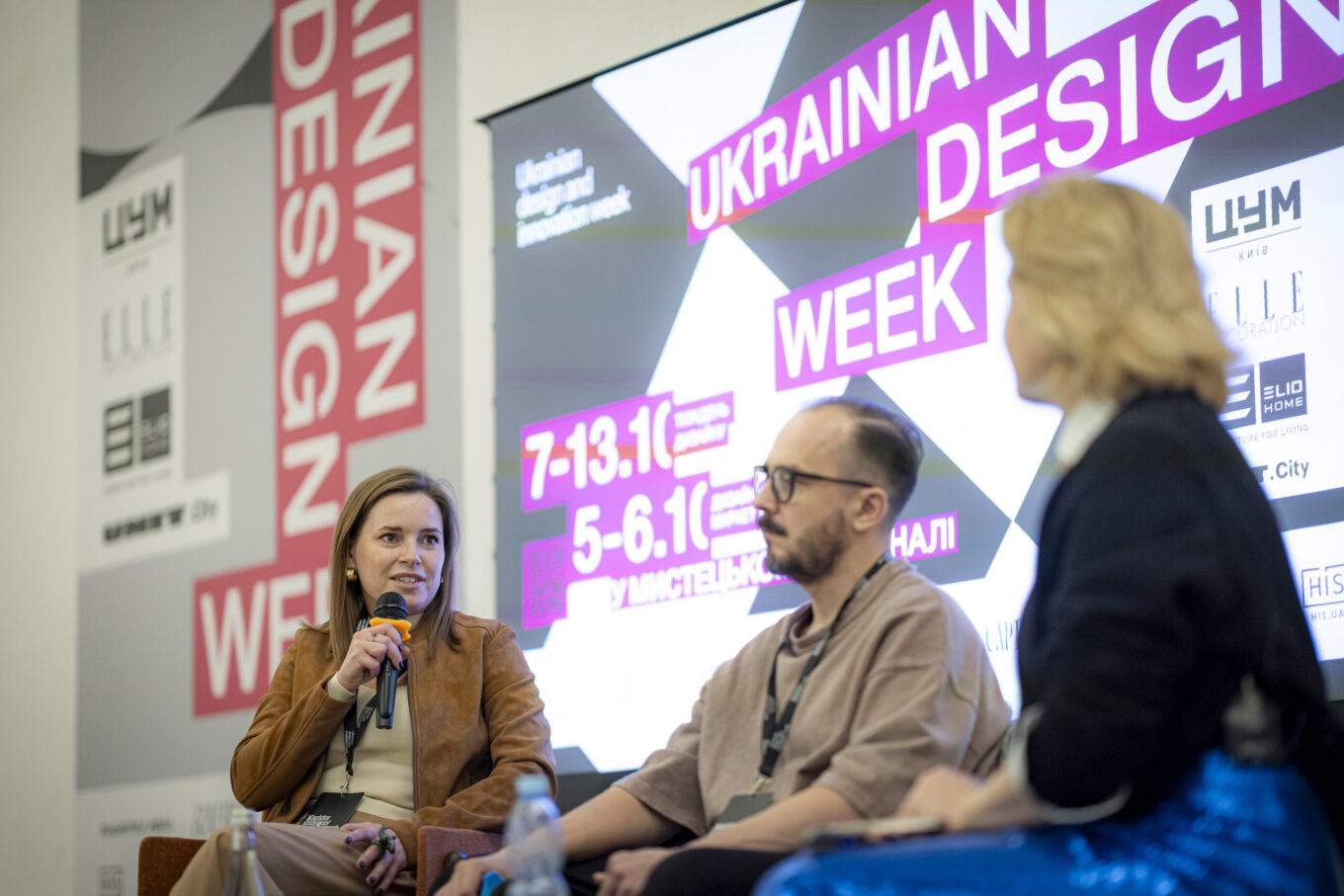
Kateryna and Anatoly Roskovshenka, organizers of Ukrainian Design and Innovation Week
“It seems to me that now the creative energy of our community is under pressure and looking for a way out. And that is why today we will see a very bright exposition. This time we already have 120 brands, including many flagships of various directions,” said UDIW co-organizer, design architect Anatoliy Roskovshenko.
Kateryna Roskovshenko, designer and co-organizer Ukrainian Design Week: “Did we want to make an all-Ukrainian “cut”? Definitely yes. Do we have brands, conditionally, from Galicia? Yes. Many brands came here from Lviv, Transcarpathia, Dnipro, and Kharkiv — we aimed to gather a layer of the best manufacturers from different parts of the country.”
PRAGMATIKA.MEDIA talked to artists and brand owners and found out what unites all those who, despite the war, continue to create things that generate new meanings. It turned out that the main factors characterizing the design community in 2024 were the deep integration of the Ukrainian subject design market into the international space and the deepening of the division of the artistic design environment into two key currents. “I have a vision that two directions of design are developing in parallel in Ukraine today. The first is a modern technological design that corresponds to global trends. The second is a design with ethnic motifs. They are equally interesting and, importantly, do not compete with each other. The division into two branches of design is a unique Ukrainian phenomenon,” said Anatoly Roskovshenko.
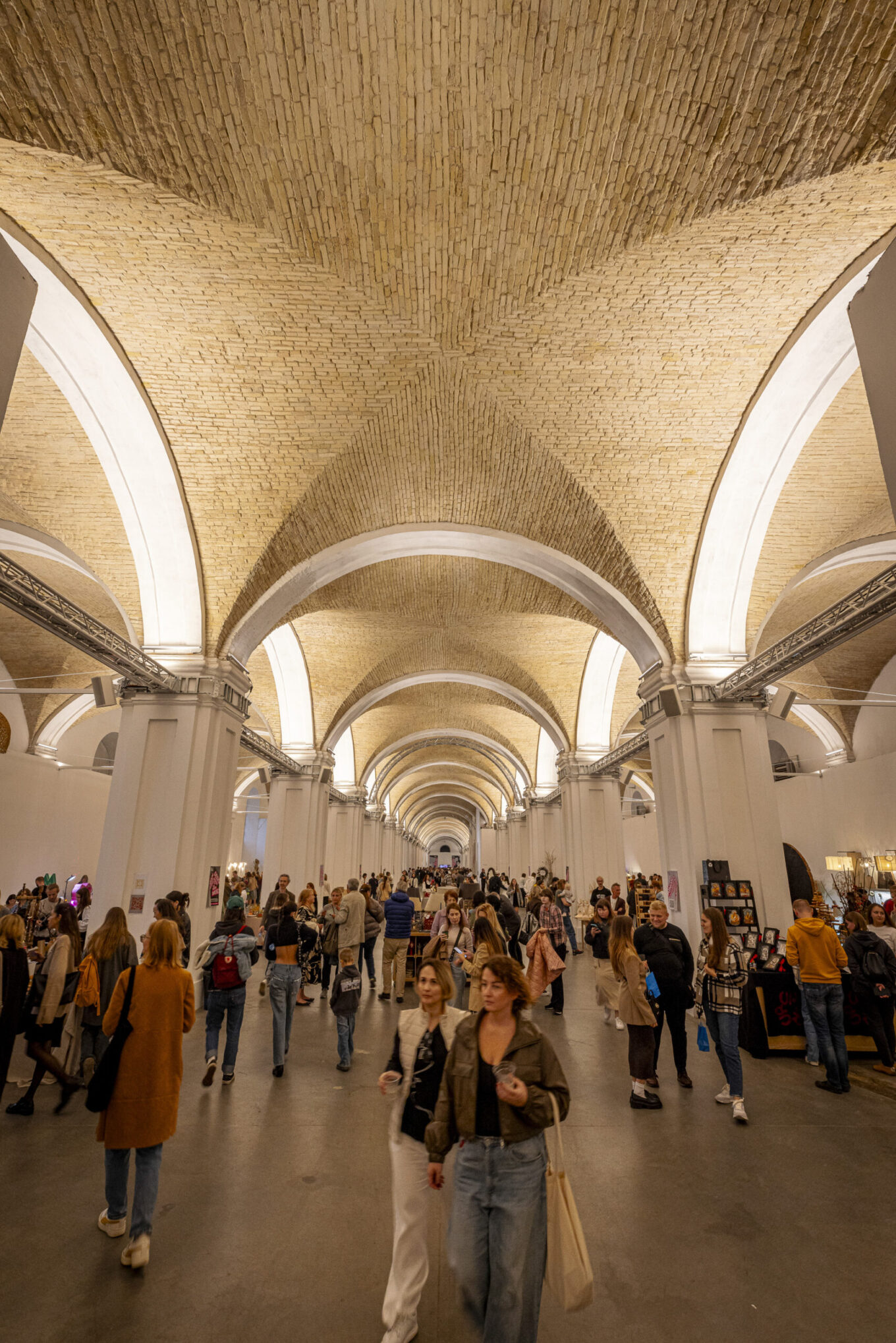
More than a hundred designers presented their works in the Art Arsenal within the Design Market. The exhibition area reached 1000 square meters
According to the co-organizer of the event, designer Kateryna Roskovshenko, Art Market and Design Market were created precisely to support this phenomenon. Currently, a confident expert, a very important thing is happening in both directions of the Ukrainian design industry: a layer of first-echelon brands is forming that will go down in history.
“Did we want to make an all-Ukrainian “cut”? Definitely yes. Do we have brands, conditionally, from Galicia? Yes. Many brands came here from Lviv, Transcarpathia, Dnipro and Kharkiv – we aimed to gather the best producers from different parts of the country. There are no randoms here. I would sum it up with the formula: stylistics, quality and compliance with modern trends, i.e. representativeness,” said the artist.
Ethnicity that shocked the world: unique materials, techniques and approaches from representatives of the “ethnic stream”
The brands that exhibited works belonging to the “ethnic” cluster of Ukrainian design at the Design Market+Art Market this year have united in their desire to present ceramics in a new way. They demonstrated interesting ideas, interesting techniques and even interesting stories about how their products impressed guests of international exhibitions in the centers of world design. Among the key representatives of the “ceramic wave” is the founder of the AMAZE brand, Anait Danielyan. This year, the architect presented her new collection of ceramic vases in the shape of arches.

Designer Tetiana Nikitina and Anait Danielyan, founder of the AMAZE brand. At the Design Market, Anait presented a new line from her collection of vases in the shape of arches.
“This is a gallery line of colored azure vases, produced in a limited series of 15 pieces of each color. We will no longer release them. Today you can see things that I have not shown before. They were occasionally presented at the PANOPTIKUM exhibition, which was held at DVRZ, but there was not a complete collection, but only a few products that we had time to make at that time. We came to Design Market+Art Market because it is a multidisciplinary and art-design project that unites manufacturers, designers and architects, and I really like this format. Everyone will find their consumer and their place here,” said Anait Danielyan.
Anait Danielyan, architect and designer: “Nowadays, many small creative teams, collaborations and studios are emerging, so I foresee a rapid development of the craft industry”
At first glance, the products of this collection do not have a functional purpose, because you cannot put a large bouquet of flowers in such a vase. However, each of them will be a luxurious gift. “The idea is that if you buy this piece for the home, it will be a decoration of your home and can become part of your collection. You will be able to think about which color is still missing or which flower you need to buy and dry to complete the composition,” stressed Anait. The collection, which provokes creative thinking and the development of imagination, was presented under the slogan “Unleash Your Creativity”, which contains a call to release your creativity and create your own set. And this is relevant not only for ordinary visitors, but also for designers.
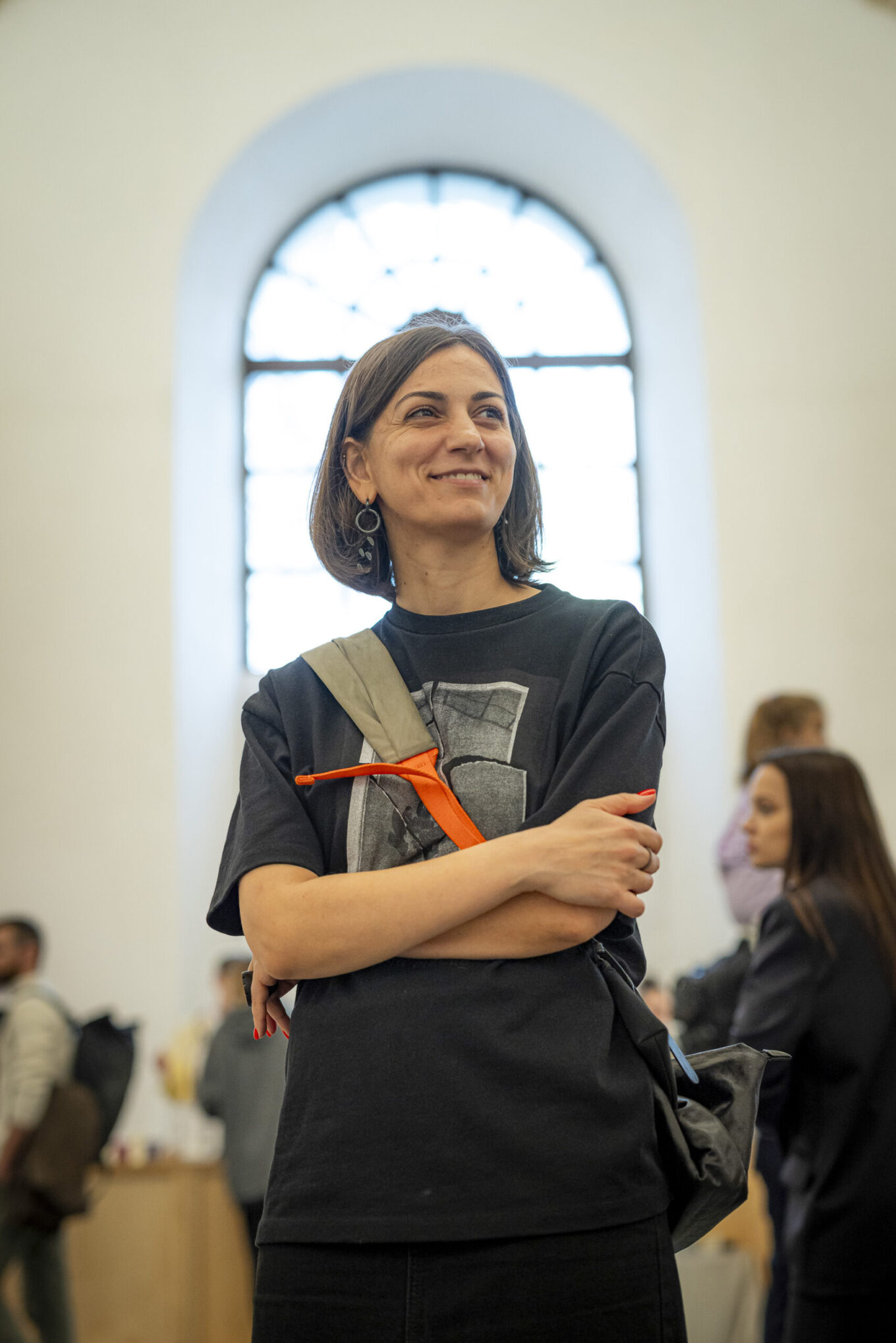
Anait Danielyan, founder of the AMAZE brand and co-founder of the DVRZ Design Days design festival
“Many small creative collectives, collaborations, and studios are emerging now, so I foresee a rapid development of the craft industry. By the way, many manufacturers started working not only with ceramics, but also with gutta. I like the fact that Ukrainian glass and tempered glass technology are being revived,” said Anait Danielyan.
Traditional materials, symbols and colors traditionally used by Ukrainian craftsmen are presented at UDIW by a number of Ukrainian brands. One of the brightest is Gunia. The consultant of the company’s showroom in Kyiv, Yaryna Travnikova, exhibited a collection inspired by the aesthetics of the Ukrainian spring at the Design Market + Art Market. The designers who created the products were inspired by the pysankarya of Kharkiv region and Polissia. “These semi-porcelain plates, teapots and cups use patterns from Easter eggs. There are animalistic prints, such as the amulet lamb, a symbol of dignity and courage. By the way, such drawings were often used as an ornament not only on Easter eggs, but also on walls. In particular, on the walls of stoves. It is also worth noting that all these products are handmade,” said Yaryna Travnikova.

The organizers aimed to gather a layer of the best design producers from different parts of the country
Oleksandr Dymnich, executive director and partner MAKHNO Studio: “When we exhibited in New York, local ceramists asked how many parts we used to make such products. We said that from one, but they are as follows: “What, seriously? Didn’t you bake it in parts? Well, it’s like, wow!“ And comes, you know, self-awareness. That is, being here during the war, you do not realize that you are setting a certain trend. If we talk about ceramics, our technologies are far ahead of others”
Gunia masters paint dishes by hand. All products of the collection are unique, therefore, comparing two plates, you will immediately see the difference. “Somewhere there can be a more saturated color, somewhere – slightly different lines. Everything depends on how our craftsmen will see the drawing and ornament,” added Yaryna.
Another bright representative of the ethnic cohort at the Design Market + Art Market is MAKHNO Studio, which presented the collection of designer Serhii Makhno ZEMLYA. The products of this line are made from clay mined in those southern regions of Ukraine that are currently in the front-line zones and under occupation.
“Clay is part of the earth, and the earth is part of our environment. Earth is what we literally live on. That is, in fact, these are our experiences, in particular during the war: loss of land, finding land, finding a new generation. We used clay from Southern Ukraine, which was seized and partially destroyed. If someone doesn’t know, our deposits of high-quality clay are now on the verge of occupation,” said Oleksandr Dymnich, executive director and partner of MAKHNO Studio.
The line, which has already been exhibited at world venues, contains about 30 ergonomic art objects capable of turning your interior into an art space. While working on the collection, the brand’s specialists consulted with ergonomics specialists — this helped to combine conceptuality and practicality.
“Yes, the line has products with ceramic parts that have soft linings. However, the collection is primarily valuable because these things are not about everyday use, they are about the integration of art and the interior and the reinterpretation of clay as a material. Last year, part of the collection was presented in a studio in New York, and the craftsmen there appreciated our works very highly. For example, you see a bench, right? When we were exhibiting in New York, local ceramists asked how many parts we used to make such pieces. We said that from one, and they were like: “What, seriously? Didn’t you bake it in parts? Well, it’s like, wow!” And comes, you know, self-awareness. That is, being here during the war, you do not realize that you are setting a certain trend. If we talk about ceramics, our technologies are far ahead of others,” Oleksandr Dymnich added.
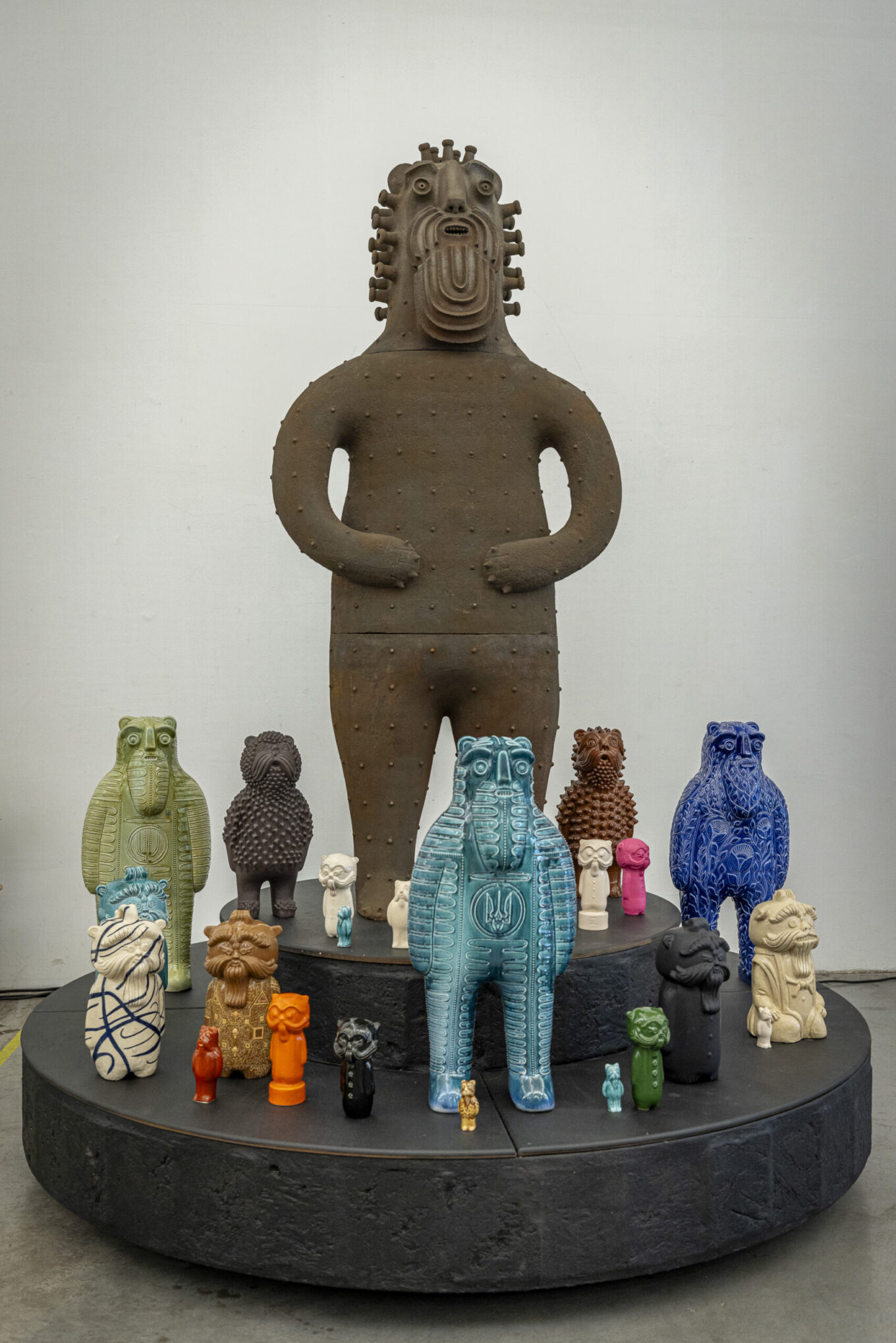
DIDO are giant ceramic sculptures from MAKHNO, which the brand positions as “artistic talismans”. Each DIDO is handcrafted
The largest art objects of the ZEMLYA collection are huge clay DIDOs. They were not baked whole, but in parts, because only an object up to a meter high can be baked in an ordinary pottery kiln. Each DIDO is made by hand: first the mold was poured, then the seams were rubbed and the patterns were applied. As a result, it turned out not just art objects, but a kind of artistic charms. “DIDO is a reinterpretation of zoomorphic ceramics, which were part of our culture and perceived as a symbol of wealth. These were usually drinking jars or decorative elements. DIDO are symbols of the past that we integrate into our future,” said Oleksandr Dymnich.
Products made of recycled plastic, a sofa-transformer and street furniture that are not afraid of rain — Ukrainian design in the context of global trends
Each designer who prefers to work in the “Ukrainian in a global context” style has his own context, ideas and way of talking to the audience. For example, +kouple brand co-founder Denys Vakhrameev prefers experiments with form and associations. Instead of putting certain ideas into his works, he leaves the final interpretation to the discretion of the audience.
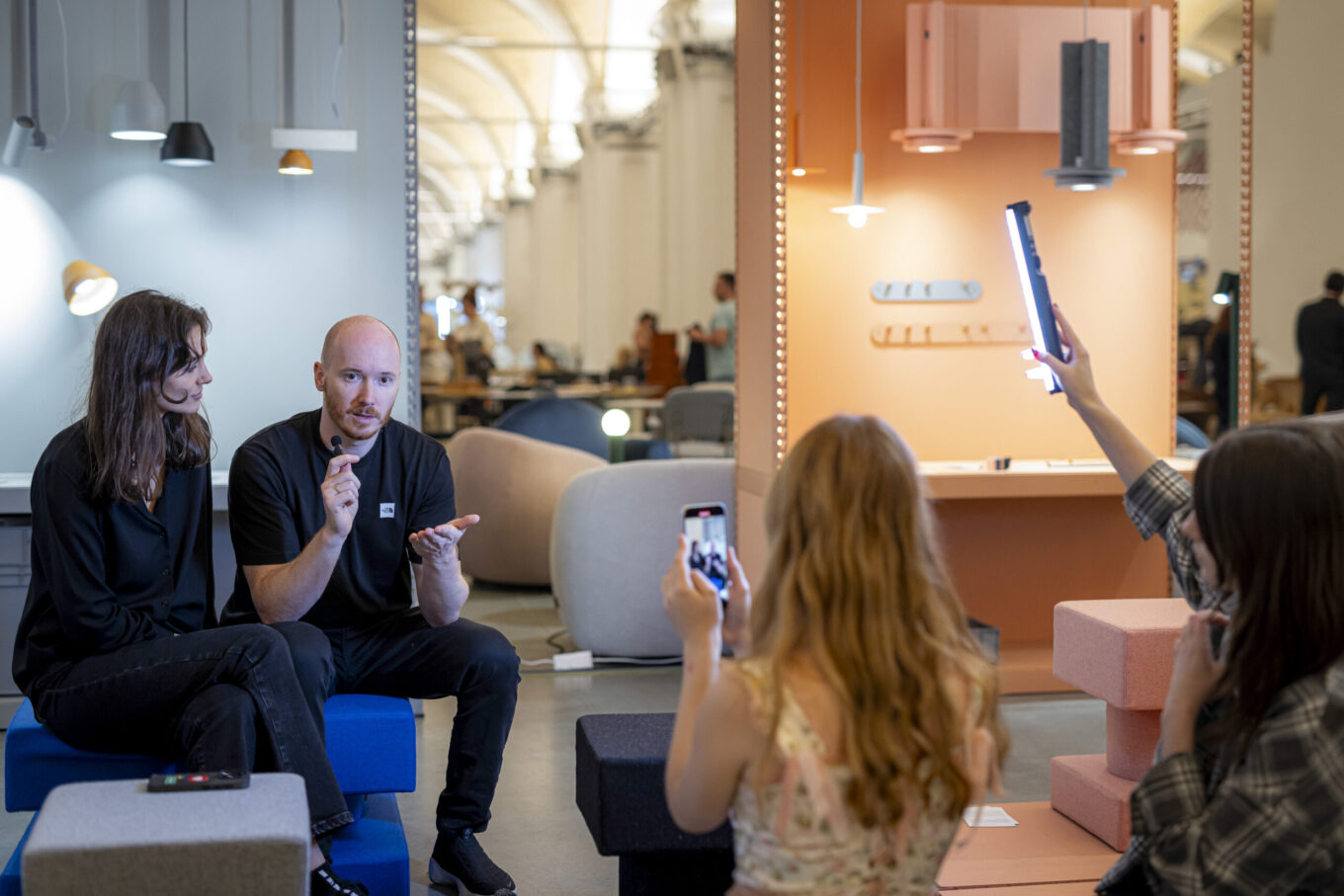
Co-founders of the +kouple brand Kateryna and Denis Vakhrameeva record a video blog against the background of the brand’s exhibition
“We don’t do it the way it’s usually done: ‘oh, what a thing, it must be some kind of design.’ We have everything in the details. We also play with materials, lighting and forms. For example, the BLT Collection: everyone decided that a round lamp is standard, so they made square ones. Similarly with poufs: how many of them already exist in the world, and they are all square or round. In the sense that it is either a cube or a tube. We have neither a tube nor a cube, but a new interesting shape. And about these objects – see, they look like chess pieces? We were also told it looked like cufflinks. However, this form is more like a chessboard to me. Now you and I are playing in the association,” said Denys Vakhrameev.
Kateryna Vakhrameeva, co-owner of the brand +couple: “Our brand started with the fact that we wanted to create items outside of seasonality. People sometimes research trends to fit into the strategic marketing stream, but we had a feeling that when you do what you love, it becomes “out of time“. It is very cool when the season changes the season, but regardless of the change in style, the subject does not age, but acquires value and remains relevant and interesting.”
In the end, Denys decides to talk in detail about the collection of JEFFREY lamps. “The material they are made of is recycled plastic. It’s a bit like wool, so everyone says it’s like felt,” said the designer.
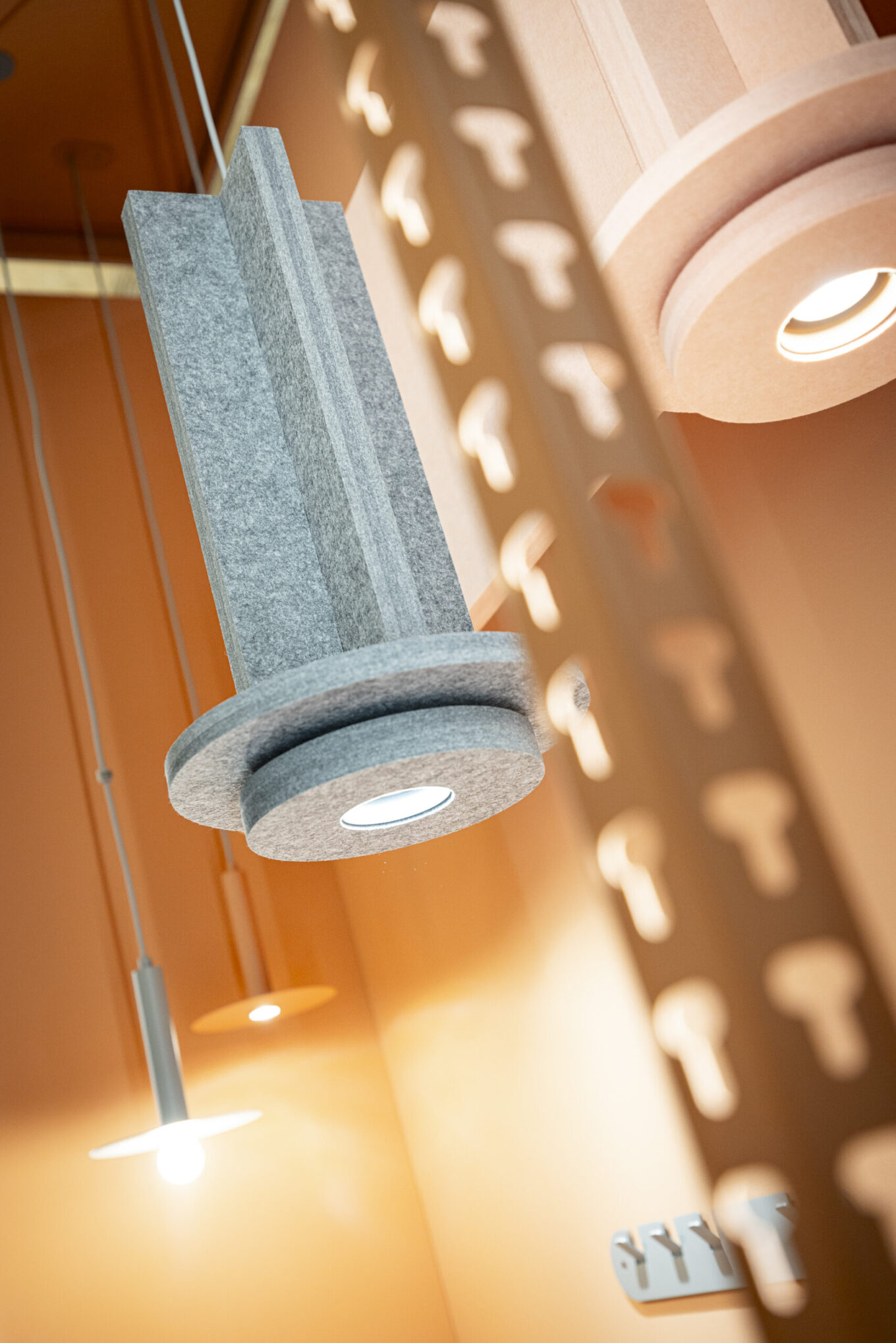
JEFFREY transformer lamps from the +kouple brand, made of recycled plastic
JEFFREY lamps are transformers. They consist of interconnected panels that allow you to change the shape of the finished product to your taste: the owner can turn the lamp into an “endless” strip, square or abstract shape. If desired, he can also buy additional panels or, conversely, reduce the number of elements. The general impression of the collection is timelessness and independence from trends. It seems that the potential for universal associative transformability will allow these products to fit into any context.
“Our brand started with the fact that we wanted to create items outside of seasonality. People sometimes research trends to fit into the strategic marketing flow, but we had a feeling that when you do what you love, it becomes “timeless”. It is very cool when the season changes the season, but regardless of the change in style, the subject does not age, but acquires value and remains relevant and interesting. In the end, it seems to me that if earlier, twenty years ago, there were recognizable branded things, now there is no single style in the world anymore – everything has become eclectic. Plus, there are no more borders from the point of view of sales and communications… That is, there is no restriction that if you, for example, work in the Scandinavian market, you must be in the appropriate style. If you invest in what you like, you will always have an admirer. And such purity and relevance for all times is probably where we started and what we stick to,” added +kouple brand co-owner Kateryna Vakhrameeva.
Individuality as a value is also important for another brand presented at the Design Week — kint. This year, kint took a course to support young designers: the main exhibits of the collection, presented by the brand’s founder Maksym Kulik, were created by young masters. “This is the puffa system, our bestseller: there is a pouf, a sofa, an armchair and a bench. And this is a novelty of 2024 — a paper table made of stainless steel. There is another novelty: the falda chair. This is a soft accent light chair on soft legs. It was the result of a closed format competition that we held among subject designers,” Maksym Kulik said.
The founder of the kint brand Maksym Kulik (in the center) tells guests about the puffa system chair by designer Rostik Sorokovy
The company approached the task using an approach typical of Western brands: a competition was announced based on a pre-prepared brief. In the brief, it was written in detail what exactly the brand wants to get as a result and what rules should be followed so that the model fits into the existing assortment. As a result, kint received 40 concepts. “Actually, 40 concepts is a lot. We didn’t even expect such a stir! We printed out all the images, spread the printouts on the table and voted for the candidates we wanted to keep. We received a lot of good options, but, unfortunately, we could only leave two,” Maksym Kulik shared his impressions. The author of the chosen version was the designer of objects and interiors Maria Seleznyova.
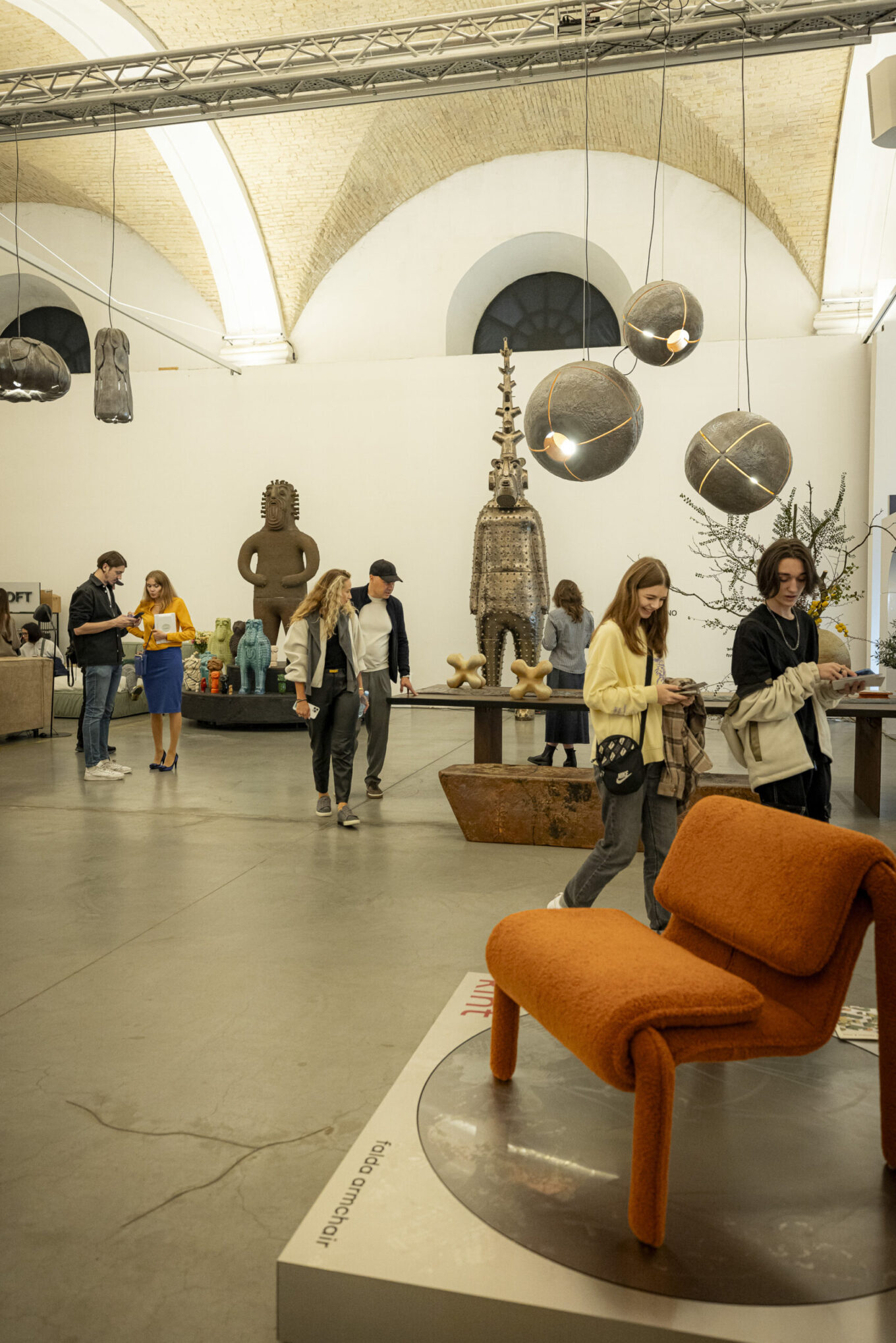
Falda chair by kint (foreground) and MAKHNO ceramic display (background)
Max Voitenko, designer and creative director of the kint brand, who was the author of the above-mentioned competition, presented the Rura convertible sofa at the Design Market + Art Market. “It looks like a 30s design: chrome tubes, tube frame design. I really like this style. Rura is translated from Polish as a trumpet,” said Max Voytenko.
Max Voytenko, designer and creative director of the kint brand: “I didn’t make design calculations – I just had a feeling that it would work. And big brands like to calculate everything, predict everything… Meanwhile, the number of requests grew – one classy hotel from Austria needed several such sofas. Eventually I suggested DIZA cooperation The owner of this company is an adventurous person. He likes challenges”
The design of this sofa was created back in 2019 — for a competition from a French retailer. “Somehow I got the idea that all sofas and chairs are basically static, but it would be cool if something changed in them: something could be moved, adapted. And I had the idea to make the roller, which is the backrest, move and transform the object: turn into an armrest and move back, giving it a different meaning and changing the configuration,” said Max Voytenko.

RURA sofa. This is a collaboration between the DIZA brand and the creative designer of the kint brand Maksym Voytenko. Photo source: DIZA
In the 2019 competition, the concept did not win, but since the visualization was already ready, Max posted it on the Internet. The photos went viral, and people who wanted to buy a new sofa started writing to the designer. In the end, the DIZA brand took up this thing. “Some brands took the sofa into development and worked on it, but in the end the model was not suitable due to the complexity and unpredictability of the process of its manufacture. The fact is that the moment of the metal pipe supporting the roller was very hypothetical. I didn’t make design calculations – I just had a feeling that it would work. And big brands like to calculate everything, predict everything… Meanwhile, the number of requests grew – one classy hotel from Austria needed several such sofas. In the end, I offered DIZA cooperation. The owner of this company is an adventurous person. He likes challenges,” said Max Voytenko.
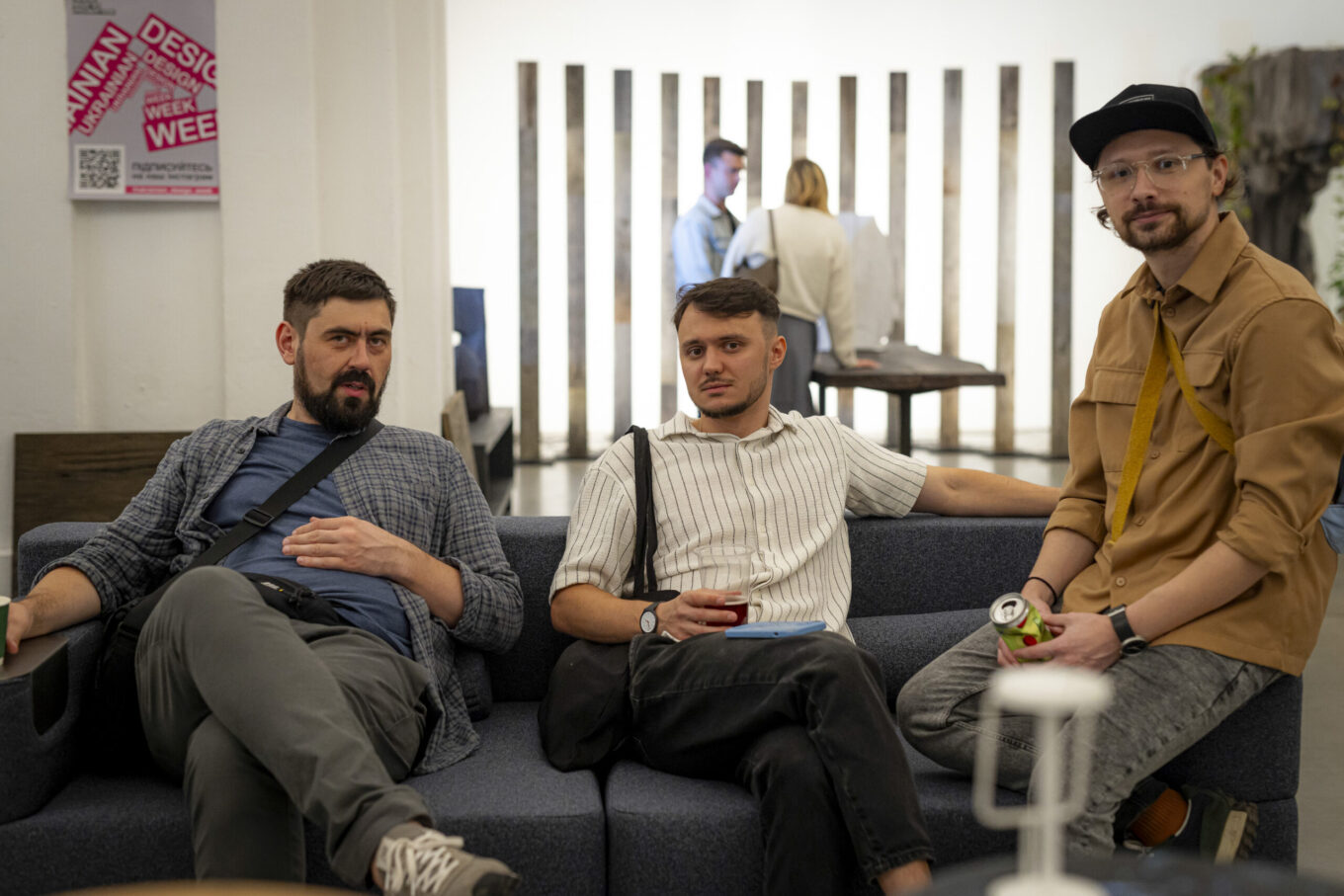
Designers Max Voytenko (kint), Vladyslav Tolochko (Shishka project) and Rostyk Sorokovy (kint, Joyf, WOO)
When the sofa was finally made, it turned out that everything worked: the pipe bent exactly as it should. “We later made a stainless steel version, and now that model is selling quite well,” he concluded. The designer is currently working on a chair with a similar design and is looking for new ideas. When asked to explain how designers combine forms, materials and meanings, he answers: “We absorb a lot – contexts, information, forms, colors. And often we can’t even explain – where this form came from, why now. It simply somehow transforms itself into us,” he explains.
A form that has a function or is itself a function is one of the most interesting ideas presented at Design Market + Art Market. In addition to the Rura sofa, this look is also represented by the TUbe outdoor furniture collection from the Joyf brand. They were presented by the author of the line — designer and creative director of the propro brand and founder of the Lviv design studio MUDU Rostyslav Sorokovy. “We wanted to create an eye-catchable collection – so that the design spoke about the brand, and we got TUbe. It is a set of objects, each of which consists of several individual flexible aluminum modules. It all started with a bar stool, and then a stool, a bench and two tables — a low and a high one — were added,” said Rostyslav.
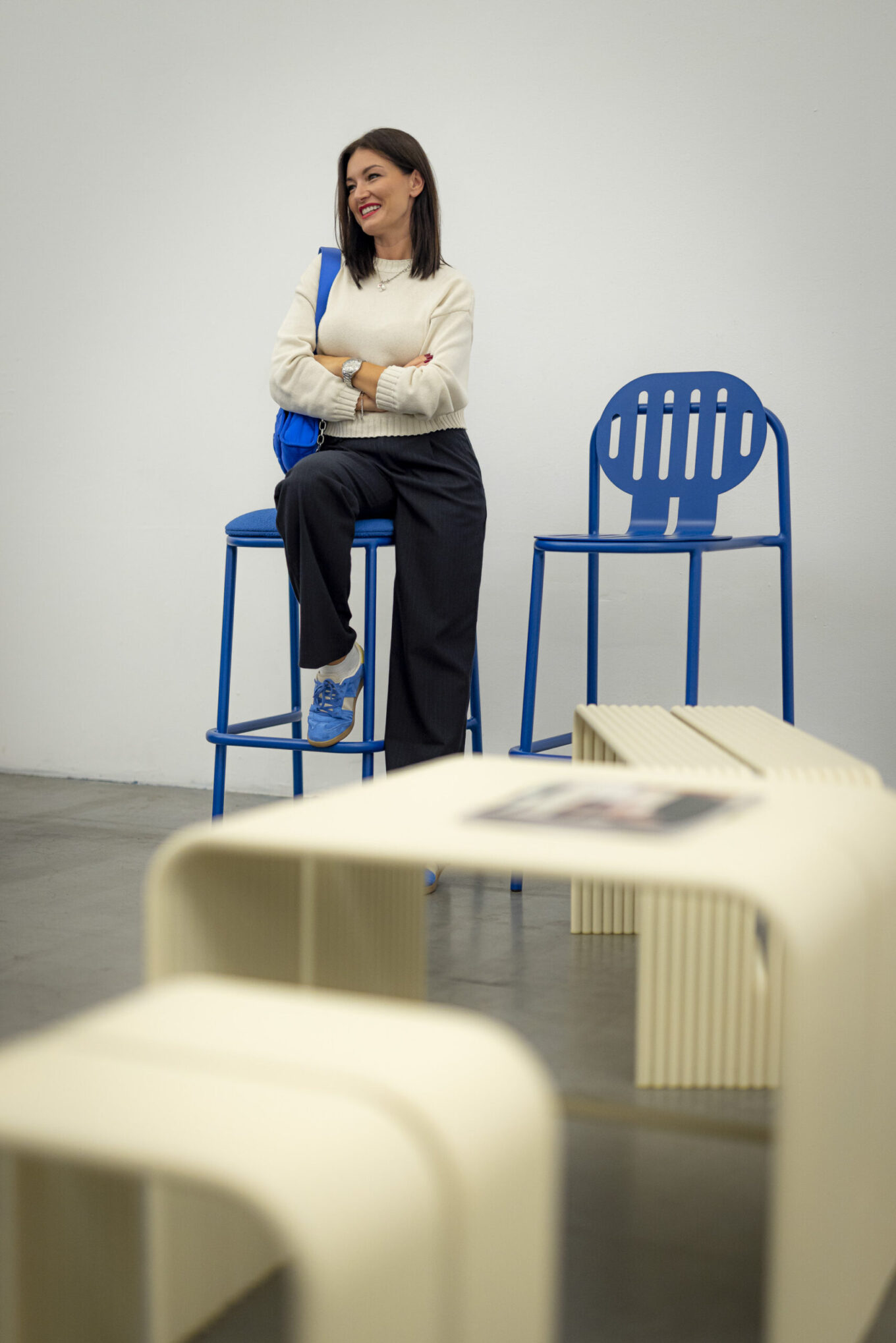
Outdoor furniture from the Joyf brand. Designer Rostyslav Sorokovy was responsible for the concept
Rostyslav presented at Ukrainian Design Week not only TUbe, but also many other novelties that he created for various brands — kint, Joyf, propro and WOO. And yet this year, TUbe is the most interesting find, because all items in the collection are incredibly ergonomic – they practically do not get wet in the rain. “In addition to TUbe, you should also pay attention to Dot, which is a collection of products made of cork wood. Can they also be called street furniture? Yes. But they can be both for the street and for the home,” said Rostyslav Sorokovy.
High-quality affordable furniture made of ecological materials at Design Market + Art Market is a separate trend. In addition to outdoor furniture from young designers, you can also see offers from brands that position themselves as “design that becomes accessible.” For example, the owner of the WOO brand, Dmytro Slinkov, always wanted to help people who do not have enough money for expensive conceptual things to still achieve their goal.
Dmytro Slinkov, owner of the WOO brand: “The designer receives income from each product we sell. We took this model as a basis because it seemed to me from the very beginning that this is the only way to properly engage, cooperate and collaborate with the designer. By the way, at the moment when we started, no one in Ukraine was working under this system.”
“It was my personal pain: I wanted to buy designer furniture, and what I liked was very expensive. We are trying to make quality things more accessible to the Ukrainian consumer,” said Dmytro Slinkov. According to the entrepreneur, now his company is doing everything to become not only affordable, but also unique. “The brand has been around for 9 years, but before the full-scale invasion, we only made low-key models. Now everything is changing, because we decided that now we will only do what we always wanted, but always limited ourselves. We thought that people probably don’t need it. People need something less accented and more calm… And when the war started, we realized that we had to export. Life is changing, and in order to maintain the company, it is necessary to enter the international market,” explained Dmytro Slinkov.
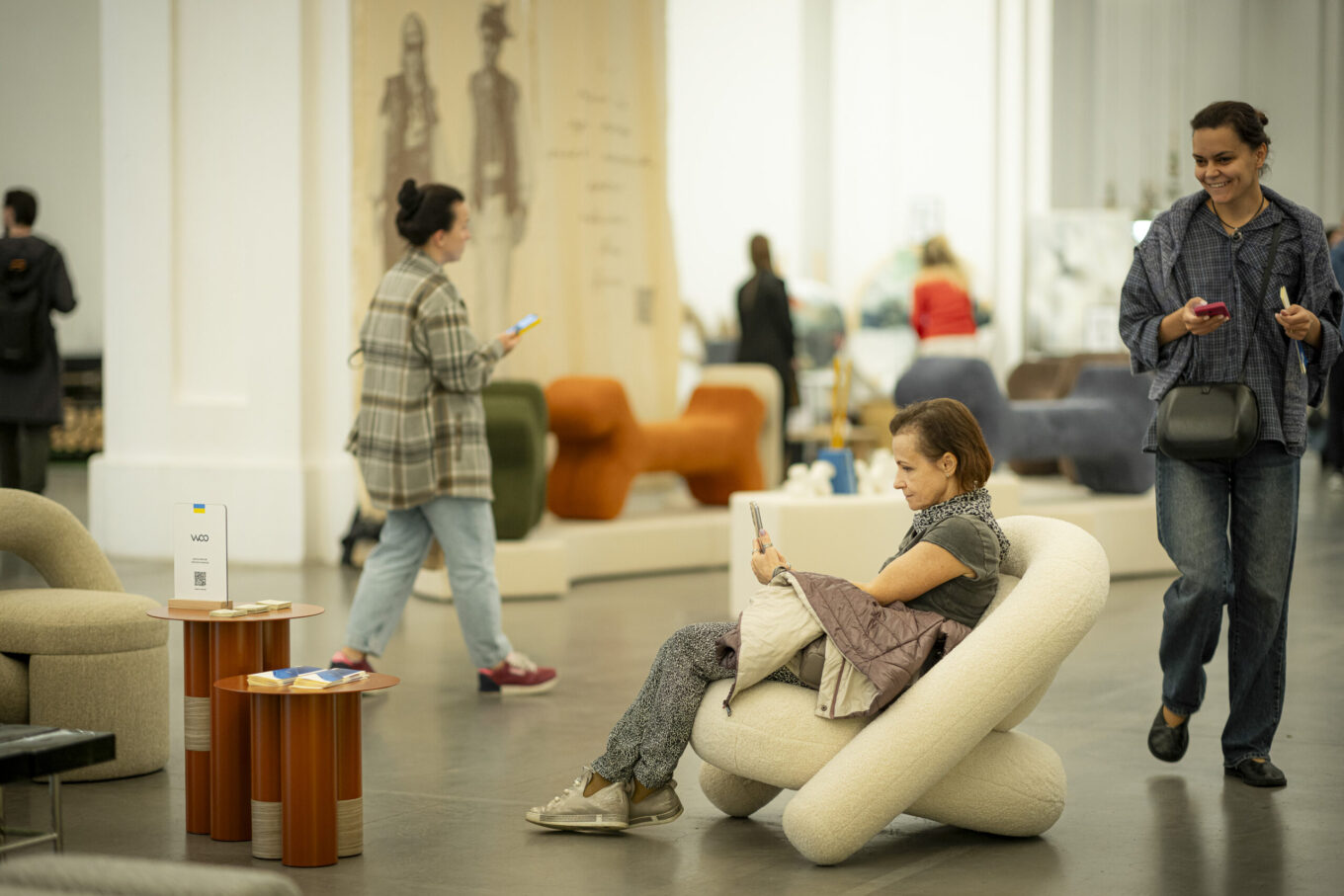
A visitor to the Design Market tests the BUN chair from the Ukrainian brand of upholstered furniture WOO
This season, WOO presented many novelties at Ukrainian Design Week: PLAY chairs, which received the award as the best chair of 2022 from Interior Design Magazine (USA), LAYERS coffee tables, BUN chair and many other interesting things. “And this table is not ours. This is a Murano glass table by Yacht Design. This is an exclusive collector’s item – only two were produced. Yacht Design is selling it to support an employee currently on the front line. They want to buy him a new car,” Dmytro Slinkov said.
A large number of novelties, and therefore a great desire for cooperation, is not the only thing that WOO can interest designers. Dmytro Slinkov said: the company cooperates with partners under the royalty program. “The designer receives income from every product we sell. We adopted this model as a basis because it seemed to me from the beginning that this was the only way to properly engage, collaborate and collaborate with the designer. By the way, at the moment when we started, no one in Ukraine was working under this system,” said Dmytro Slinkov.
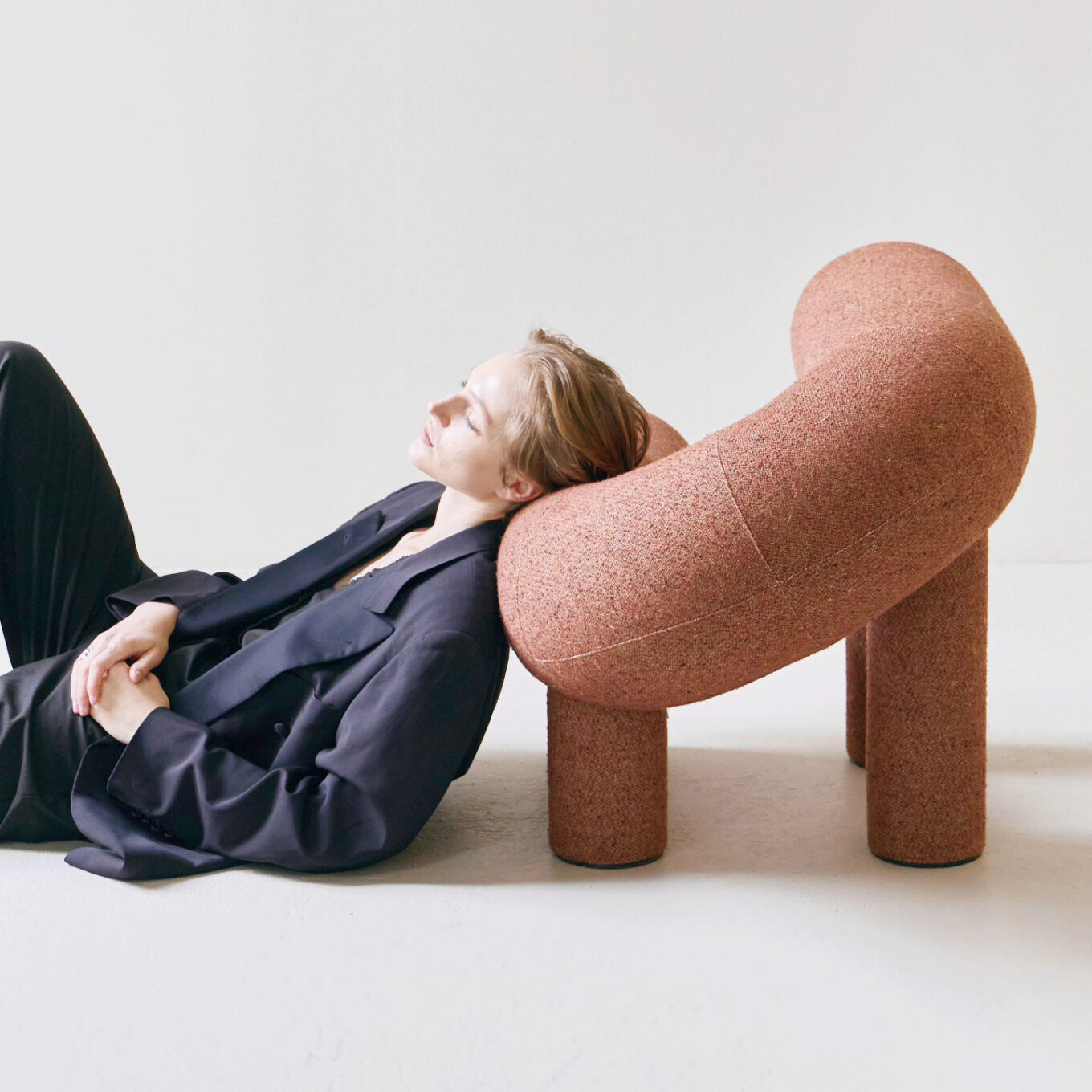
UMI armchair from the Ukrainian brand WOO. The author of the concept is designer Rostyslav Sorokovy. Photo source: WOO
The two main criteria for selecting works for further cooperation are, firstly, the ability to express oneself succinctly and, secondly, a high rating from the owner of the brand: almost all items from the company’s collections, Dmytro admits, are at home. As for the first, it is the uniqueness — the minimalism of the object and its emphasis — that is important, because WOO consider furniture as something that embodies a certain idea and has a simple form at the same time. “A very important point: we pay more and more attention to convenience and ergonomics. Today, we are no longer ready to make compromises: if it is something very interesting, but inconvenient, we will not do it,” Dmytro Slinkov stressed.
One of the designers who know how to create minimalism with a deep meaning is Vladyslav Tolochko. This year, together with the Shishka project, he presented the Moti (Mochi) chair. “The idea lies in the name itself – it’s a Moti dessert. When you take it out of the fridge, it’s still a little frosted, so we’ve specifically chosen velor to mimic that effect. Moti (Mochi) is an item for HoReCa, offices and lounge areas. We can make an option without an armrest and a table – we give the client complete freedom of choice. By the way, this time we presented another option – Dino. This is a chair for HoReCa with a homely interior – you can just sit down and relax in it,” said Vladyslav Tolochko.
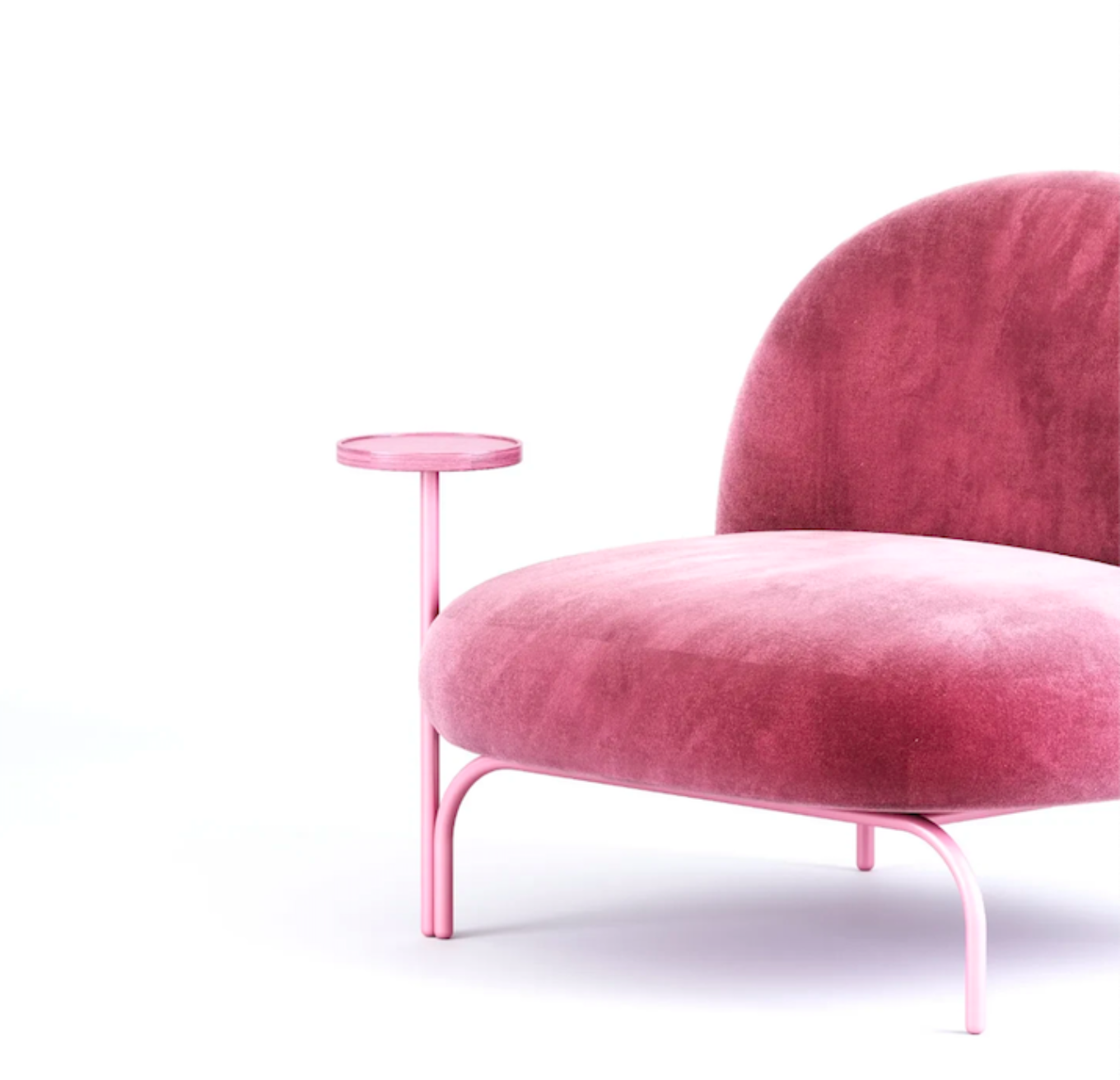
The Moti (Mochi) armchair by Vladyslav Tolochka is reminiscent of the Japanese dessert mochi
The designer characterizes his style as bright modern minimalism. He likes to work with a form that is emphasized by color, complemented by system details such as tables and armrests and changes depending on the parameters. And Design Market + Art Market became exactly the place where Vladyslav was able to receive feedback on each of his finds.

The queue of visitors on the second day of the Design Market in the Art Arsenal
“There was a lot of feedback both from fellow designers and simply from customers. It is very important for me to understand what the client feels, the person who sits on my chairs and communicates with my furniture. It is very valuable for me that I become a small part of the lives of people who put my items in their interior. For me, this is the highest value! After all, it is very important for us to convey the value of all these objects, because it is not just beauty for beauty’s sake, aesthetics for aesthetics’ sake, function for function’s sake. No. Each subject has its own philosophy. If you now choose a certain designer of a certain object in the hall and approach him, he will give you an hour-long monologue about why it was done that way. Why such a material or such an angle. Each designer leaves a piece of himself in each item,” he said.
Source of all photos: Design Market+ART MARKET
link