
An innovative and sustainable design of intangible Miao wax printing patterns in combination of diffusion model and fuzzy TOPSIS
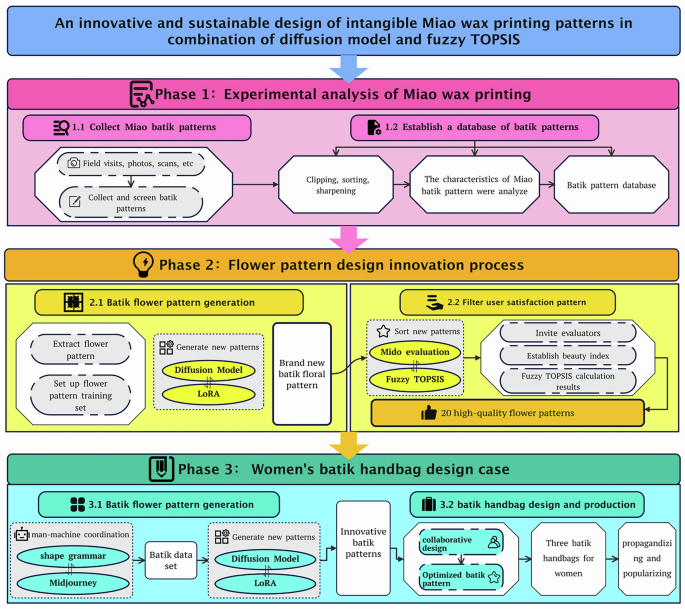
Database construction of Miao wax printing transfer model
The batik patterns of the Miao ethnic group in Guizhou represent the essence of Miao batik art and serve as a distinctive marker that differentiates it from other ethnic artistic forms. To construct a training database with high cultural recognizability and pattern comparability, the research team initially collected 1500 representative Miao batik samples from relevant books, online resources, and Miao handicraft e-commerce platforms. Based on initial screening criteria-including stylistic representativeness and pattern completeness-500 structurally complete batik images were selected.
Given that floral motifs in traditional Miao totems not only exhibit strong esthetic expressiveness but also embody the community’s beliefs regarding nature, life, and fertility, they were chosen as the primary training targets for this study. Using Photoshop for image segmentation, 200 structurally coherent and symbolically rich floral patterns were extracted from the 500 samples. These were uniformly cropped to 512 × 512 pixels and systematically labeled to form a refined training subset. The selected images exhibit high comparability in terms of cultural symbol density, compositional style, and symbolic significance, serving as a critical foundation for the subsequent joint training of LoRA and the diffusion model.
DM combines LoRA model to generate innovative flower and plant patterns
During the model training phase, the pre-trained diffusion model stable diffusion 1.5 was selected as the base model and integrated with LoRA fine-tuning techniques to reduce the number of trainable parameters and enhance training efficiency. The training parameters were set as follows: each floral pattern image was repeated three times (repeat = 3), with 50 training epochs (Epoch = 50) and a batch size of 16 (Batchsize = 16). This configuration ensured efficient training while enabling the model to sufficiently learn the detailed structures and stylistic features of Miao floral patterns.
To ensure that the model could capture the symbolic cultural meanings embedded in the floral motifs, a prompt system incorporating compositional information and culturally significant keywords was specifically constructed. For instance, prompts such as “petals radiating from four corners” or “eight-petal lotus at the center” correspond to traditional Miao batik symbols representing prosperity, purity, and fertility. These culturally embedded prompts were repeatedly invoked during training, allowing the model to learn not only visual forms but also to internalize the structural features of totemic language at the latent level. A real-time loss monitoring mechanism was employed during training, and every five epochs, a manual cultural verification process was conducted. This process involved inviting evaluators with Miao cultural backgrounds to assess the symbolic similarity between the intermediate generated patterns and traditional reference samples using a double-blind evaluation method. This step ensured that the model outputs remained consistent with the core cultural esthetics. Upon completion of training, 100 sets of floral patterns were generated using random seeds (Seed = 0–99). While keeping the primary generation configurations consistent, controlled adjustments were made to the learning rate (ranging from 1e-5 to 1e-4) and the CFG Scale (ranging from 7 to 12) to explore the model’s sensitivity to visual attributes such as symmetry, pattern saturation, and symbolic clarity. Based on structural coherence, cultural relevance, and esthetic performance, 30 high-quality floral patterns were selected for subsequent user evaluation.
Fuzzy TOPSIS screens out and ranks the patterns with high esthetics
In this study, after the 30 innovative flower and plant patterns generated in the previous stage are exported and saved, a questionnaire of esthetic degree is designed and 44 Miao wax printing lovers are invited to objectively give scores on them from the five dimensions of symmetry, balance, structure, proportion and overall unity; the top 20 flower and plant patterns most in line with public esthetics are selected as samples for subsequent experiments.
Determination of evaluation index
Determining evaluation index is a key step in the fuzzy TOPSIS method. The evaluation index should fully reflect the customer’s esthetic satisfaction to the flower and plant patterns. In this questionnaire design, the key evaluation indexes are selected as symmetric, balanced, rhythmical, proportional, and harmonious, and overall unity. The seven-level Likert scale is used to set a scale from 1 to 7. The respondents choose an option that best represents their opinions according to their real feelings, and the customer’s evaluation is blurred by language variables (Table 1).
Construction of fuzzy matrix of flower and plant patterns evaluation
The evaluation data of 44 Miao wax printing lovers on 30 innovative flower and plant patterns are collected to generate fuzzy decision matrix. The elements in the matrix are the fuzzy scores of each flower and plant pattern under each index. Firstly, the language evaluation of each flower and plant pattern under each evaluation index is converted into the corresponding fuzzy number to form the initial fuzzy decision matrix. The rows of the matrix represent the evaluation indexes, which are respectively B1 symmetric; B2 equilibrium; B3 strong rhythm; B4 proportional harmony, and B5 overall unity; the column represents 44 evaluation subjects; the elements in the matrix are corresponding fuzzy numbers.
Standardized fuzzy evaluation decision matrix
Secondly, according to the nature of the index, the fuzzy decision matrix is standardized. For the positive index (the larger the value is, the better it will be), the fuzzy number can remain unchanged; for the negative index (the smaller the value is, the better it will be), the fuzzy number needs to be transformed (such as taking the reciprocal). Finally, the standardized calculation is carried out. Each fuzzy number is divided by the maximum value under the corresponding indicator or normalized according to certain rules. Then a standardized fuzzy decision matrix is obtained. The standardized fuzzy decision matrix is the final matrix used in fuzzy TOPSIS analysis. This matrix will be used as the basis for calculating fuzzy ideal solution and negative ideal solution, distance, and relative proximity.
In Table 5, the sequence number 1 of flower and plant patterns in the standardized fuzzy evaluation matrix is calculated, which is taken as an example. This set of data is standardized; the standardized formula is used and the standardized values are: (0.000, 0.071, 0.143).
$${\rm{x}}^{\prime} =\frac{x-{x}_{\min }}{{x}_{\max }-{x}_{\min }}$$
(7)
The fuzzy positive ideal solution and fuzzy negative ideal solution of the scheme are determined
Fuzzy positive ideal solution and fuzzy negative ideal solution are determined. The fuzzy positive ideal solution is for each evaluation index. As the data is a very large index, the optimal value is selected from the weighted fuzzy decision matrix to form a fuzzy positive ideal solution. For a forward indicator, FPIS is the upper maximum of the fuzzy number. Similarly, the worst value is selected from the weighted fuzzy decision matrix to form a fuzzy negative ideal solution.
Calculation of the distance between positive and negative ideal solutions in the scheme
The distance between positive and negative ideal solutions in the scheme is calculated. The Euclidean distance calculation formula is used to calculate the distance between positive and negative ideal solutions. D* represents the distance from the positive ideal solution; D- represents the distance from the negative ideal solution. Define the distance between No. a(a = 1, 2, …, n) evaluation object and the maximum value as Da* = \(\sqrt{\mathop{\sum }\limits_{{\rm{b}}=1}^{5}{({{\rm{B}}}_{{\rm{b}}}^{+}-{{\rm{b}}}_{{\rm{ij}}})}^{2}}\) ; define the distance between No. a(a = 1, 2, …, n) evaluation object and the maximum value as Da– = \(\sqrt{\mathop{\sum }\limits_{{\rm{b}}=1}^{5}{({{\rm{B}}}_{{\rm{b}}}^{-}-{{\rm{b}}}_{{\rm{ij}}})}^{2}}\).
Calculation of the relative closeness between each flower and plant pattern and positive and negative ideal solution
The relative closeness of a single pattern in a group is obtained; According to the Euclidean distance formula, the distance between the positive and negative ideal solutions is calculated by equipartition. A set of positive and negative ideal solutions for a single scheme is obtained. The relative closeness (S^) of all schemes is calculated in this way (Table 2):
$${{\rm{S}}}_{i}^{* }=\frac{{D}_{i}^{-}}{{D}_{i}^{* }+{D}_{i}^{-}}$$
(8)
The higher value of (S^) represents the higher preference of the scheme. Therefore, the following ranking results can be obtained from Table 3: P10 > P4 > P6 > P8 > P1.
In the process of using the fuzzy TOPSIS method to evaluate the scheme, the five evaluation indexes have the same important influence on the esthetic degree of flower and plant patterns, so they are not weighted. The ranking of all the final pattern schemes in the sample is calculated by fuzzy comprehensive evaluation method. Through the evaluation experiment, we select the top 20 innovative flower and plant patterns which are more in line with the public esthetic expectations (Fig. 2). On this basis, the subsequent wax printing pattern design is carried out to ensure that the overall style of the innovative wax printing pattern conforms to the modern esthetic trend of the public.

Top 20 innovative flower pattern displays in terms of esthetics.
Human-AI collaborative innovation design of innovative Miao wax printing patterns in Guizhou
Extraction of Miao wax printing structure
The basic layout structure is extracted from the traditional Miao wax printing patterns. The wax printing patterns are classified according to different geometric shapes such as triangles, squares, and circles. The common layout structure of Miao wax printing patterns can be summarized, such as “nine-square grid” and “Mizi grid”. The structure of Miao wax printing patterns is extracted and numbered into Guizhou wax printing database so as to provide reference data and creative basis for the generation of subsequent innovative patterns.
Wax painting is deduced by shape grammar
The basic composition elements and basic flower and plant patterns of Miao wax printing pattern is defined. The basic flower and plant patterns are formed according to the deduced rules of rotation, superposition, and shift. Based on the structure of “nine-square grid” or “Mizi grid”, it is placed into the traditional Miao wax printing structure. Designers use the flexibility of rules to explore new ways of composing Miao wax printing patterns.
Innovative wax printing pattern design in combination of artificial intelligence
Based on shape grammar to deduce wax printing patterns, keywords such as “Miao wax printing”, “geometric flowers and plant” and “symmetry” are input into the AI image generation platform Midjourney. The similarity, size, and other parameters are set to quickly generate innovative wax printing patterns (Fig. 3). After screening and cutting, the denoising and random generation mechanism of DM is used to enrich the details and variability of the pattern; the new Miao wax printing pattern after man-machine collaborative innovation is obtained.

Shape grammar combined with Midjourney painting software to innovatively design.
Designers creates the women’s handbag with Guizhou wax printing
This study explores the integration of traditional Guizhou batik esthetics with contemporary design concepts by employing shape grammar and AI technologies to generate innovative wax printing patterns. Unlike general-purpose AI image generation platforms, this approach employs a custom-built image database of Miao floral batik motifs to fine-tune a LoRA model, ensuring that the AI system focuses on learning the unique visual language and compositional structures inherent to Miao batik.
In the pattern composition stage, shape grammar is introduced to regulate the structural logic of the motifs, and Miao batik artisans are invited to participate in the selection and refinement process. This establishes a Human-AI collaborative design mechanism that significantly enhances both semantic accuracy and the continuity of traditional craftsmanship. By dynamically calibrating cultural styles, this method effectively mitigates the risk of cultural misrepresentation. To further demonstrate the applicability and scalability of the proposed AI-based generation method in diverse cultural and creative product design contexts, it was extended to household goods such as pillows and bed linens, as well as fashion items including cloth shoes and backpacks (Fig. 4). A women’s batik handbag was selected as the primary prototype for small-scale production to validate the practical feasibility of the design output. During the prototyping phase, a simple and elegant tote bag style was chosen to highlight the visual impact of the batik patterns. Natural elements such as bamboo joints and peach wood were incorporated to enhance both environmental sustainability and product durability. The production process strictly adhered to traditional batik craftsmanship, including fabric preparation, wax application, dyeing, dewaxing, and sewing-all carried out by Miao artisans. The entire production cycle lasted five days, with only one day required to progress from AI-generated pattern to final drawing application-significantly reducing the design timeline compared to conventional hand-drawing methods.

Design renderings of cultural and creative products featuring batik motifs.
The final product achieved 98% visual similarity to the original AI-generated image, validating the capability of AI to translate traditional motifs into practical applications. A product promotional shoot was conducted for the batik tote bags (Fig. 5), and marketing was implemented via social media, fashion exhibitions, and online platforms. This approach infused the tote bags with a distinctive cultural narrative, enabling consumers to better understand and appreciate the cultural significance behind the product, thereby enhancing its cultural value and market appeal. Lastly, 44 Miao batik enthusiasts were invited to evaluate three batik tote bag styles. Using a 7-point rating scale, all three bags received scores above 5 across five esthetic criteria, with average satisfaction exceeding 6-indicating strong positive feedback and widespread user recognition (Fig. 6).

Product display of women’s fashion handbag.

Public evaluation of batik handbags according to Mido indicators.
While the study received highly positive evaluations through small-scale prototyping, the future application of AI models in large-scale manufacturing and commercial contexts may still pose potential risks, including the oversimplification of symbolic motifs, excessive stylization, and the erosion of stylistic diversity. Therefore, while improving design efficiency, it is crucial to ensure normative guidance and cultural control within the generative process. By constructing a Human-AI co-creation framework and incorporating manual feedback and cultural oversight mechanisms, the training, generation, and evaluation processes can be optimized. This approach can effectively prevent disconnection from cultural contexts, ensuring that AI-generated outcomes align not only with visual features but also with the deeper essence of traditional craftsmanship and cultural logic.
link